Hungarian Rhapsody No. 2
A slow introduction, then a dance that keeps getting faster – the piece everyone knows from cartoons where somebody is sat down at a piano.
The piece at a glance
- Composer
- Franz Liszt
- Year
- 1847
- Origin
- S. 244/2
- Key
- C# minor
- Level
- Advanced
- Keys recommended
- 88
How difficult is it?
Octave leaps, double notes and a cadenza shaped freely by the player. One of the best-known showpieces there is, and demanding to match.
The real hurdle
The cadenza before the final section is free – no metronome helps here, only your own idea of where it is going.
How long does it take?
The slow introduction in weeks, the fast section in months to years.
A rule of thumb, not a rule – how fast it goes depends on prior experience and practice time. This level is an assessment, not a measurement: most pieces exist in arrangements ranging from heavily simplified to concert level. The rating refers to the common arrangement.
Which instrument suits it?
Needs the full 88 keys and an action that carries fast repetition. On short keyboards the ending is missing.
Instruments that suit it
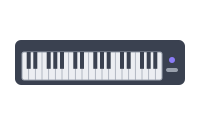 Roland FP-E50 EU approx. €690–780
Portable digital piano with PHA-4 Standard action.
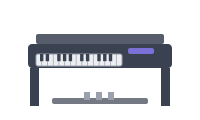 Yamaha Clavinova CLP-845 EU approx. €2,200–2,600
The Clavinova upper class: GrandTouch-S action with wooden keys – CFX plus Bösendorfer Imperial on board.
 Kawai MP11SE EU approx. €2,200–2,350
Stage piano with Grand Feel action.
The catalogue lists 233 instruments with verified data – key count, action and connections documented rather than claimed.
Where to find the sheet music
The work is in the public domain: the term of protection – 70 years after the composer’s death – has expired. Note that a modern engraving or a new arrangement can still be protected. What is free are the old editions, not automatically every version.
Free: the historical editions
IMSLP holds the old, public-domain editions as PDFs – free and legal. Engraving and fingering reflect their era; anyone wanting a modern, easily readable edition is often better served by a paid one.
Modern editions and arrangements
Simplified versions, modern engraving and arrangements are available from the usual sheet music retailers. We will add direct links here shortly.
Frequently asked questions
How difficult is Hungarian Rhapsody No. 2?
Octave leaps, double notes and a cadenza shaped freely by the player. One of the best-known showpieces there is, and demanding to match.
What key is Hungarian Rhapsody No. 2 in?
Hungarian Rhapsody No. 2 is in C# minor.
How many keys do you need for Hungarian Rhapsody No. 2?
88 keys are recommended.
Who composed Hungarian Rhapsody No. 2?
Franz Liszt, 1847.
Can you download the sheet music for Hungarian Rhapsody No. 2 for free?
The work is in the public domain: the term of protection – 70 years after the composer’s death – has expired. Note that a modern engraving or a new arrangement can still be protected. What is free are the old editions, not automatically every version.
How long does it take to learn Hungarian Rhapsody No. 2?
The slow introduction in weeks, the fast section in months to years.
If this suits you
 La Campanella Franz Liszt
The little bell – one of the most notorious études in the repertoire, famous for leaps across two octaves.
Flight of the Bumblebee Nikolai Rimsky-KorsakovThe Bumblebee – the piece by which speed has been measured for as long as pianos have existed.
Mazeppa Franz LisztOne of the hardest études ever written: the theme sits in the middle of the hand while thirds and sixths race …